Eric Enderton


Eric Enderton
|
|
| NVIDIA Director of Film Rendering Technology (my day job). Formerly Principal Research Scientist. |
| Digital Production Symposium (DigiPro) Organizer and former conference chair. |
|
Academy Software Foundation (ASWF)
Technical Advisory Committee representative for NVIDIA.
ASWF Digital Production Example Library (DPEL) Technical Steering Committee chair. |
| Journal of Computer Graphics Techniques (JCGT) Editorial Board member. |
| AMPAS member, Visual Effects Branch. |
|
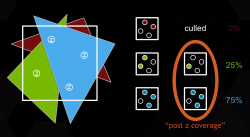
Accumulative Anti-Aliasing (talk)
Eric Enderton, Eric Lum, Christian Rouet, Oleg Kuznetsov ACM SIGGRAPH 2015 Talks [Web site][corrected images]
Accumulative anti-aliasing (ACAA) is a simple modification of
forward-rendered multi-sample anti-aliasing (MSAA). It produces
the same image quality but consumes half as much multi-sample
framebuffer memory, and reduces both render time and off-chip
bandwidth by 20% to 30%. ACAA stores multiple depth samples,
computed by a depth-only pre-pass, but stores only one color sample
per pixel, which is used to accumulate final color as the sum
of shaded fragment colors weighted by visibility. ACAA makes
higher sample rates practical, improving image quality.
|
|

|
Proceedings of DigiPro 2016, the Digital Production Symposium
July 23, 2016 Program Chairs: Jonathan Gibbs, Chris Horvath. Conference Chairs: Andrew Pearce, Eric Enderton. [Program] [Proceedings] [fxguide article]
Conference:
Papers and talks on character rigging, pipeline frameworks, the jungle in Jungle Book, the colors in ACES, and clouds in VR. Also Andy Lomas's high-dimensional searches for art, and Jason Smith's keynote on technological leaps of faith at ILM.
|
|

|
Proceedings of DigiPro 2015, the Digital Production Symposium
August 8, 2015 Program Chairs: Larry Gritz, Jonathan Gibbs. Conference Chairs: Eric Enderton, Phil Peterson. [Program] [Proceedings] [fxguide article]
Conference:
Papers and talks on particles, pipelines, ocean sim, hair sim, color spaces, and even octopuses.
|
|

|
Proceedings of DigiPro 2013, the Digital Production Symposium
July 20, 2013 Program Chairs: Eric Enderton, Nafees Bin Zafar. Conference Chairs: Larry Cutler, Doug Epps. [Program] [Proceedings]
Conference:
Papers and talks on character animation, large fluid simulations, set capture, stereo, and more. Keynote by Pixar's Tony DeRose.
|
|

|
Proceedings of DigiPro 2012, the Digital Production Symposium
August 4, 2012 Program Chairs: Eric Enderton, Larry Cutler. Conference Chairs: Armin Bruderlin, Ken Anjyo. [Program] [Proceedings] Conference: Ten original papers on computer graphics production, kicked off by a keynote by Joe Letteri of Weta Digital. Papers on fire, smoke, crowds, faces, stereo and more. |
|
|
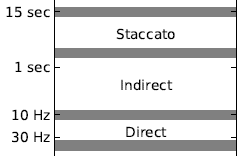
The Workflow Scale: Why 5x Faster Might Not Be Enough
Eric Enderton, Daniel Wexler Computer Graphics International Workshop on VFX, Computer Animation, and Stereo Movies, 2011 [PDF] [Discussion] [Slide] Abstract: This essay discusses qualitative versus quantitative accelerations of user tasks, in the context of computer animation production. A workflow regime is defined as a range of system response times in which the artist's relationship to the task is qualitatively similar. Radical new technology is much more likely to succeed when it brings an artist's workflow into a new regime, providing a discontinuous improvement in efficiency and final image quality. More modest technology revisions can supply smaller speed-ups, but these are merely consumed by Blinn's Law, i.e., the tendency for system response times to remain constant as technology improves, due to increased input complexity. We propose a list of workflow regimes and their ranges of response time. |
|
|
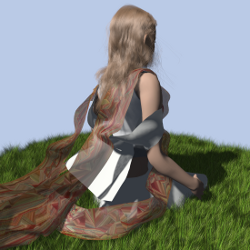
Stochastic Transparency
Eric Enderton, Erik Sintorn, Peter Shirley, David Luebke IEEE Transactions on Visualization and Computer Graphics (TVCG), August 2011. Original, shorter version: Symposium on Interactive 3D Graphics and Games (I3D) 2010 (Winner of Best Paper Award. Image selected for proceedings cover.) [PDF] [Slides] [Videos] [Code from DX SDK] Abstract: Stochastic transparency provides a unified approach to order-independent transparency, anti-aliasing, and deep shadow maps. It augments screen-door transparency using a random sub-pixel stipple pattern, where each fragment of transparent geometry covers a random subset of pixel samples of size proportional to alpha. This results in correct alpha-blended colors on average, in a single render pass with fixed memory size and no sorting, but introduces noise. We reduce this noise by an alpha correction pass, and by an accumulation pass that uses a stochastic shadow map from the camera. At the pixel level, the algorithm does not branch and contains no read-modify-write loops other than traditional z-buffer blend operations. This makes it an excellent match for modern massively parallel GPU hardware. Stochastic transparency is very simple to implement and supports all types of transparent geometry, able without coding for special cases to mix hair, smoke, foliage, windows, and transparent cloth in a single scene. |
|
|
A Local Image Reconstruction Algorithm for Stochastic Rendering
Peter Shirley, Timo Aila, Jonathan Cohen, Eric Enderton, Samuli Laine, David Luebke, Morgan McGuire Symposium on Interactive 3D Graphics and Games (I3D) 2011 [PDF] Abstract: Stochastic renderers produce unbiased but noisy images of scenes that include the advanced camera effects of motion and defocus blur and possibly other effects such as transparency. We present a simple algorithm that selectively adds bias in the form of image space blur to pixels that are unlikely to have high frequency content in the final image. For each pixel, we sweep once through a fixed neighborhood of samples in front to back order, using a simple accumulation scheme. We achieve good quality images with only 16 samples per pixel, making the algorithm potentially practical for interactive stochastic rendering in the near future. |
|

|
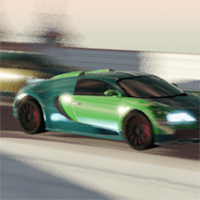
Colored Stochastic Shadow Maps
Morgan McGuire, Eric Enderton Symposium on Interactive 3D Graphics and Games (I3D) 2011 [PDF] [Slides] [Video and More] Abstract: This paper extends the stochastic transparency algorithm that models partial coverage to also model wavelength-varying transmission. It then applies this to the problem of casting shadows between any combination of opaque, colored transmissive, and partially covered (i.e., alpha-matted) surfaces in a manner compatible with existing hardware shadow mapping techniques. Colored Stochastic Shadow Maps have a similar resolution and performance profile to traditional shadow maps, however they require a wider filter in colored areas to reduce hue variation. |
|
|
Real-Time Stochastic Rasterization on Conventional GPU Architectures
Morgan McGuire, Eric Enderton, Peter Shirley, David Luebke High Performance Graphics 2010 (Second Place for Best Paper Award.) [PDF] [Slides and more] Abstract: This paper presents a hybrid algorithm for rendering approximate motion and defocus blur with precise stochastic visibility evaluation. It demonstrates---for the first time, with a full stochastic technique---real-time performance on conventional GPU architectures for complex scenes at 1920x1080 HD resolution. The algorithm operates on dynamic triangle meshes for which per-vertex velocity or corresponding vertices from the previous frame are available. It leverages multisample antialiasing (MSAA) and a tight space-time-aperture convex hull to efficiently evaluate visibility independently of shading. For triangles that cross z=0, it fall backs to a 2D bounding box that we hypothesize but do not prove is conservative. The algorithm further reduces sample variance within primitives by integrating textures according to ray differentials in time and aperture. |
|

|
Efficient Rendering of Human Skin
Eugene d'Eon, David Luebke, Eric Enderton Eurographics Symposium on Rendering 2007 (Image selected for proceedings cover.) [PDF] [Demo and more] Abstract: Existing offline techniques for modeling subsurface scattering effects in multi-layered translucent materials such as human skin achieve remarkable realism, but require seconds or minutes to generate an image. We demonstrate rendering of multi-layer skin that achieves similar visual quality but runs orders of magnitude faster. We show that sums of Gaussians provide an accurate approximation of translucent layer diffusion profiles, and use this observation to build a novel skin rendering algorithm based on texture space diffusion and translucent shadow maps. Our technique requires a parameterized model but does not otherwise rely on any precomputed information, and thus extends trivially to animated or deforming models. We achieve about 30 frames per second for realistic real-time rendering of deformable human skin under dynamic lighting. |
|

(Image by Tweak Films.) |
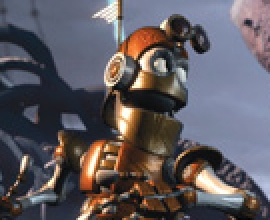
GPU-Accelerated High Quality Hidden Surface Removal
Daniel Wexler, Larry Gritz, Eric Enderton, Jonathan Rice Graphics Hardware 2005 (Image selected for proceedings cover.) [PDF] Abstract: High-quality off-line rendering requires many features not natively supported by current commodity graphics hardware: wide smooth filters, high sampling rates, order-independent transparency, spectral opacity, motion blur, depth of field. We present a GPU-based hidden-surface algorithm that implements all these features. The algorithm is Reyes-like but uses regular sampling and multiple passes. Transparency is implemented by depth peeling, made more efficient by opacity thresholding and a new method called \emph{z batches}. We discuss performance and some design trade-offs. At high spatial sampling rates, our implementation is substantially faster than a CPU-only renderer for typical scenes. |
|
(Image by Frantic Films.) |
High-Quality Antialiased Rasterization
Daniel Wexler, Eric Enderton GPU Gems II, chapter 21, 2005 [Chapter] [source code] Abstract: Finely detailed 3D geometry can show significant aliasing artifacts if rendered using native hardware multisampling, because multisampling is currently limited to one-pixel box filtering and low sampling rates. This chapter describes a tiled supersampling technique for rendering images of arbitrary resolution with arbitrarily wide user-defined filters and high sampling rates. The code presented here is used in the Gelato film renderer to produce images of uncompromising quality using the GPU. |